
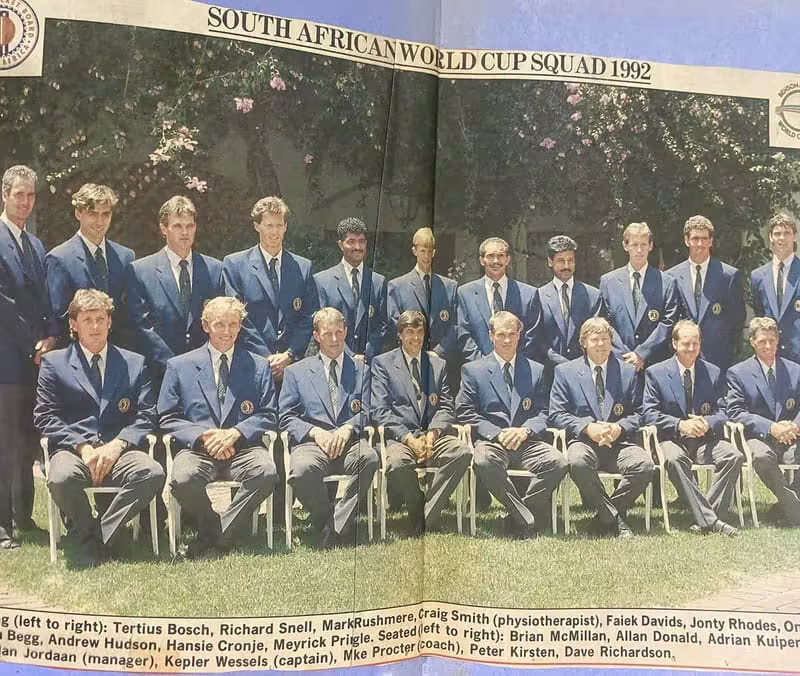
When South Africa walked out for their opening match of the 1992 Benson & Hedges World Cup, it ended 21 years of isolation from international cricket. The team that travelled to Australia and New Zealand carried the hopes of a nation still finding its way back onto the world's sporting stage.
A squad of pioneers
Captained by the experienced Kepler Wessels, the squad blended seasoned professionals with a new generation of talent who would go on to define South African cricket for the decade that followed.
- Kepler Wessels (captain)
- Hansie Cronje
- Allan Donald
- Andrew Hudson
- Peter Kirsten
- Jonty Rhodes
- Brian McMillan
- Dave Richardson (wicketkeeper)
- Meyrick Pringle
- Adrian Kuiper
- Richard Snell
- Tertius Bosch
- Mark Rushmere
- Faiek Davids
- Omar Henry
- Mandy Yachad
Mike Procter served as coach, with a seasoned management team alongside him — a pairing that helped steer the side through its first major tournament in a generation.
The campaign
South Africa made an immediate statement, beating co-hosts Australia in their opening match. Wins over Pakistan, Zimbabwe and others carried them through the group stage, and the pace of Allan Donald, supported by the seam of Meyrick Pringle and Richard Snell, quickly earned the respect of the cricketing world. Jonty Rhodes announced himself with a spectacular run-out against Pakistan that remains one of the most celebrated fielding moments in World Cup history.
Against the odds, the newcomers reached the semi-finals — a remarkable achievement for a side playing its first global tournament in more than two decades.
The semi-final heartbreak
The semi-final against England at the Sydney Cricket Ground became one of the most infamous matches in the tournament's history. Chasing 253, South Africa needed 22 runs from 13 balls when rain interrupted play. Under the much-criticised rain rule of the time, the target was recalculated in the cruellest possible way: when play resumed, South Africa needed 22 runs from a single ball. The contest was effectively over, and South Africa's dream debut ended in controversy rather than defeat on merit.
That rain rule was scrapped soon afterwards and replaced by the Duckworth–Lewis method. Yet the achievement of the 1992 squad endures: they returned South African cricket to the world, restored its pride, and laid the foundation for the great teams that followed.
